
Columbia University Graduate School of Architecture, Planning and Preservation (GSAPP) is pleased to present PEOPLE CROSS AGAINST THE LIGHT: Michael Sorkin’s New York. The exhibition brings together eight architectural projects Michael Sorkin (1948–2020) conceived for New York City, the primary site of his architectural and urban speculation, over a pivotal decade of his career. On view from February 26 through June 26, 2026, at the Arthur Ross Architecture Gallery in Buell Hall, the projects were designed between 1987 and 1996—a period that marks Sorkin’s transition from being New York’s most incisive and widely read architecture critic, through his writing for The Village Voice, to his accelerated investment in design work with his own practice, Michael Sorkin Studio.
Rather than separating his work as a critic and as a designer, the exhibition approaches them as deeply entangled. Sorkin consistently challenged authority, destabilized established power structures, and understood politics as a complex ecology shaped by multiple forces. The projects on view present the built environment as a layered field in which prevailing systems—of infrastructure, regulation, capital, and representation—can be contested through strategic acts of obstruction. In Sorkin’s work, obstruction is not a refusal but a generative tool: a means of slowing dominant forces long enough for alternative forms of collective life to emerge.
The exhibition presents more than one hundred items, including several never-before-seen large-scale models, drawings, sketches, writings, and archival material by Michael Sorkin, his studio, and collaborators such as Lebbeus Woods and John Young. Among the projects on view are two unsolicited proposals developed for the Television City site between 59th and 72nd Streets, then being developed by Donald Trump.
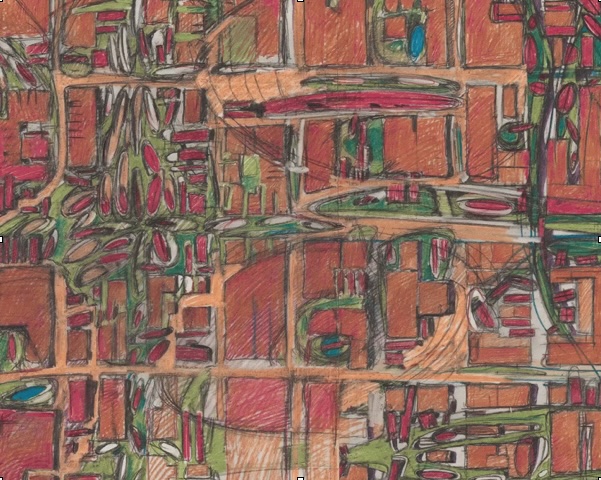
The exhibition’s title, People Cross Against the Light, is drawn from Sorkin’s 2010 essay “Nine Fabulous Things About New York.” It reflects his close relationship to the city and his attention to small, everyday acts that unsettle authority. The phrase also gestures toward the humanism that increasingly characterized Sorkin’s later work, where political imagination was grounded in lived urban experience.
Throughout a career spanning teaching, research, design, activism, acting and writing, Michael Sorkin understood stability as the by-product of diversity. This conviction helps explain both his enduring love for New York and the character of his practice. Wary of singular representations, he consistently blurred disciplinary boundaries and resisted working within a single medium or style. The eight projects in the exhibition articulate an architecture shaped by friction: between ecology and real-estate speculation, collective life and regulatory control, and digital abstraction and lived urban conditions. Projects such as Mass Movement (1987) and Time Square / The Eleventh Hour (1987) explore entertainment culture, real-estate speculation, and early digital representation in Reagan-era New York. Later works—including Animal Houses (1989-1993), Tracked Houses (1990), Church Street (1991), Shrooms (1994), the Governor’s Island proposal (1995–96), and East New York (1995-1996)—develop increasingly explicit engagements with biomorphism, infrastructure, self-reliance, and ecological urbanism. Together, these projects reveal critique not as an endpoint, but as the starting point for design.
Michael Sorkin was born in Washington, D.C. in 1948 and studied English and comparative literature at Columbia University before training as an architect at Harvard and MIT. An active writer since his undergraduate days, he began writing as the architecture critic for The Village Voice in 1978, where he chronicled New York’s architecture and urban politics throughout the 1980s. After leaving The Village Voice in 1988, he maintained an active design practice, continued his writing through other outlets including The Nation, and had a long career in teaching, including appointments at the Academy of Fine Arts in Vienna, Columbia GSAPP, and City College of New York, where he served as Professor and Director of the Urban Design Program. In 2005, he founded Terreform, a nonprofit research organization focused on more equitable and sustainable futures, followed by its publishing imprint, Urban Research.
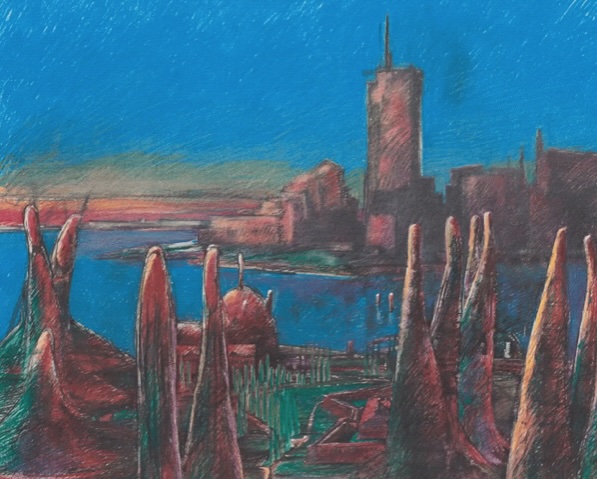
This exhibition is the first major presentation of Sorkin’s work since his death from COVID-19 in 2020, and the first overview not produced by his own office. It draws extensively from the Michael Sorkin papers and architectural drawings collection at Columbia’s Avery Architectural & Fine Arts Library, which has housed the archive since 2024.
PEOPLE CROSS AGAINST THE LIGHT: Michael Sorkin’s New York is organized by Columbia GSAPP and curated by Bart-Jan Polman, Director of Exhibitions and Public Programs and Curator of the Arthur Ross Architecture Gallery, with Jean Im, Assistant Director of Exhibitions and Public Programs.
The exhibition will be accompanied by a symposium on February 27, 2026, from 2:00–6:00 PM at the Maison Française in Buell Hall. The symposium will expand the exhibition’s framework to include discussion of Sorkin’s later work with Terreform and Urban Research. Participants include Teddy Cruz & Fonna Forman (Estudio Teddy Cruz + Fonna Forman), Ana María Durán Calisto (GSAPP; Estudio A0), Kent Hikida (OJT), Thom Mayne (Morphosis), Vyjayanthi Rao (GSAPP; Sharjah Architecture Triennial), Deen Sharp (LSE; Terreform), Andrei Vovk (Ralph Appelbaum Associates), and James Wines (SITE) and is organized and moderated by Bart-Jan Polman (GSAPP).
Gallery opening February 26/ Conference February 27 2026.Bart-Jan Polman PhD; Director Arthur Ross Gallery, GSAPP, Columbia, NY.
Email *exhibitions@arch.columbia.edu
https://www.arch.columbia.edu/events/4042-people-cross-against-the-light-michael-sorkin-s-new-york