
A talk presented at DICEA – Sapienza Università di Roma, April 2026
The 15-Minute City (15MC) is usually presented as a contemporary response to the dysfunctions of the modern metropolis — a model proposed by Carlos Moreno in 2016, in which every inhabitant can access all essential urban functions within a short walk or bike ride. This idea of a city of short and equal distances, providing increased possibilities to its inhabitants, is inherent to the concepts of development (understood as the expansion of possibilities, UNDP) and sustainability that have shaped urban thinking over the last two decades.
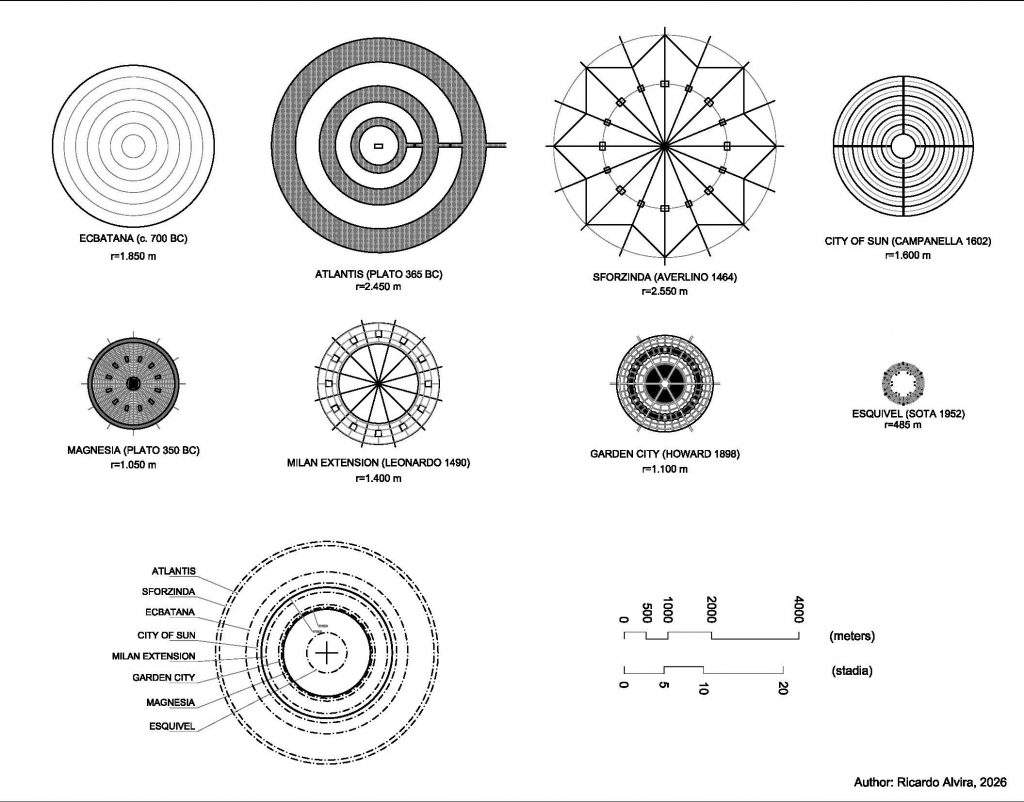
Yet the model also condenses recurring ideas throughout history: the city of short distances is far from new, with radio-centric layouts — where radial streets converge on a central core, intersected by concentric rings — standing as the optimal form from two complementary perspectives: geometrically, the circle maximizes enclosed area for a given perimeter while minimizing average distances to the centre; from a 15MC perspective, the circular boundary is the set of all points reachable in a given time, with radii as natural travel paths.
This places the focus on the Mediterranean urban model of the compact and diverse city — which tended naturally, without formal planning, toward the radio-centric form. Yet these ‘organically’ grown cities were also complemented, from the 4th century BC onward, by a lineage of deliberate urban proposals showing a remarkable continuity: from Plato’s Magnesia (c. 350 BC) to Ebenezer Howard’s Garden City (1898) and Alejandro de la Sota’s Esquivel (1952). Architects, philosophers and urban reformers repeatedly converged on the same physical form — a fully geometrical radio-centric city — and on similar design principles: polycentrism, proximity, mixed uses, and equalized accessibility.
The historical lineage
Plato’s Magnesia, proposed in the Laws (c. 350 BC), established the paradigm with remarkable numerical precision: twelve self-sufficient neighbourhood units, walking distances under 500 metres to local facilities and under 1,000 metres to city-wide services, within a polycentric urban scheme, a maximum wealth ratio of 4:1 among citizens, and a population calibrated to the ecological carrying capacity of the territory, and equal rights for men and women in education, military service, and public office — on the grounds that a state which excluded women wasted half of its potential. The city’s 2 km diameter means it took approximately 15 minutes to walk from the perimeter to the centre — a resemblance to 15MC thresholds that reflects a deep logic of human scale.
The Renaissance city-republics of northern Italy — through Filarete’s Sforzinda (1464) and Leonardo da Vinci’s proposals for Milan (c. 1490) — recovered and elaborated the radio-centric model, connecting it to Vitruvian principles, the ambition to redesign cities under the new Renaissance paradigm, the urgent need to overcome the legacy of medieval plagues, and the demands of evolving military technology, which forced cities to adapt their defences.
Howard’s Garden City (1898) incorporated mass transit to reproduce the 5-minute accessibility paradigm at a territorial cluster scale: main facilities remained accessible within a 5-minute walk, while every city in the cluster was reachable within a 5-minute train ride. He also introduced emerging non-polluting technologies such as windmills for electricity generation, and social innovations such as community land ownership, in a model that, like Magnesia, extended equal rights to women in education and public office, and pursued ideals of collective welfare — though within a framework where private interest retained a greater role.
And in 1952, Alejandro de la Sota embedded these principles into Esquivel, a rural colonisation village built under Spain’s Instituto Nacional de Colonización, arguably the first built example of a radio-centric city directly influenced by Howard, hidden in plain sight behind a layer of Andalusian tradition. Its outer radius of approximately 400 m closely matches that of the dwellings in Palmanova, suggesting a practical upper limit for fully realised radio-centric layouts, and pointing to the radio-centric scheme as an underlying form rather than a rigid pattern.
The unfinished circle
The historical record reveals a broad consensus on the physical form of the sustainable city across 2,400 years. Yet we find no similar agreement on its political configuration, which has received far fewer explicit design proposals.
This is most likely due to political context: only proposals developed under conditions of relative political freedom — Athenian democracy and 19th-century Britain — articulate original political models, typically oriented towards strengthening collective agency. Proposals produced in autocratic contexts (Sforzinda under the Sforza; Esquivel under Franco) not only avoid proposing alternative political designs but even conceal their sources to escape censorship.
The physical and political configuration of the city have thus developed independently, a finding that collides with a long-established insight: in the V century BC, the urban planner Hippodamus already understood, as Mumford noted, that the form of the city is the form of its social order.
To close the circle, the 15-Minute City still needs to define its political geometry.
This work draws on a previous collaboration with Emeritus Professor José Fariña Tojo, who passed away in February 2025, and is dedicated to his memory. Part of the research was carried out during a stay as Visiting Professor at DICEA, Sapienza Università di Roma, in 2025.