
A shaded courtyard, a welcoming square or a pedestrian route can shape university life as much as a classroom. These are places where students exchange ideas, staff meet across disciplines and visitors encounter the institution. Rethinking campus public spaces means recognising their contribution to learning, health, belonging and the relationship between universities and cities.
This vision is at the heart of the Festival of University Campus Public Spaces, taking place on 5 February 2027 at DICEA–Sapienza Università di Roma, Via Eudossiana 18, Rome. With Marichela Sepe as General Chair, the Festival will bring together research and design perspectives to explore how university environments can become more liveable, inclusive, resilient and connected.
The Festival includes the Second International Urban Design Conference, “Public Spaces for Community Campuses and Universities”, with the GUDesign Network as a conference partner. Building on the first conference, it advances a discussion that extends beyond institutional boundaries: how can university spaces support both academic communities and the everyday life of surrounding neighbourhoods?
The Festival will also present the results of three research projects: NARRATES, TASTE Sapienza and LOVE Sapienza. Their inclusion will connect the international debate with research on university spaces and their urban relationships, providing an opportunity to discuss findings and exchange perspectives among researchers, designers and university communities.
A campus brings together many functions of a city. Teaching, research, housing, food, mobility, culture and recreation generate different rhythms and demands. Its public realm connects these activities, creating opportunities for informal learning, rest and social interaction. Courtyards, gardens, paths and shared interiors form an interconnected system of places where university life unfolds.
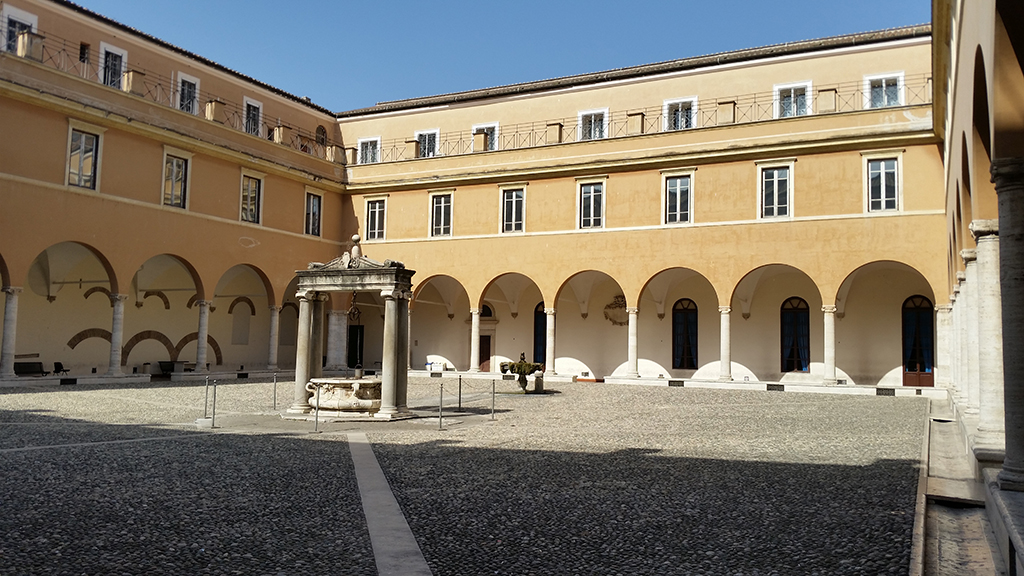
The challenge is to accommodate diverse communities. Students, academics, technical and administrative staff, visitors and residents experience university environments differently. Accessible routes, varied seating, clear information and welcoming settings can support participation across ages, abilities and cultural backgrounds. Listening to users during planning and management helps translate inclusion into everyday experience.
Health and environmental comfort are central to this approach. Trees, shade and sheltered seating can make outdoor spaces more inviting as climatic conditions change. Walking routes and opportunities for physical activity can become part of daily routines. Canteens, outdoor eating areas and shared tables connect access to healthy food with conviviality. Together with cultural activities, these spaces support a broader understanding of campus wellbeing.
These relationships inform the conference’s four thematic strands. The first, developed with EURA, addresses liveable, resilient and inclusive university public spaces through analysis, design and best practices. The second explores healthy food, cultural heritage and sport. The third examines campus–city relationships through universal accessibility, proximity and multimodal connections. The fourth considers artificial intelligence, technologies and emerging hybrid uses of traditional campus spaces.
The invited speakers bring together complementary perspectives from international practice and academia. Henriette Vamberg, Gehl Architects, will discuss campus life and space; Armand Paardekooper, Mecanoo, will explore the campus as a city and the city as a campus; and Chris van Duijn, OMA, will address the open campus and the next generation of higher education.
Thomas Woltz, Nelson Byrd Woltz Landscape Architects, will examine the formative influence of academic landscapes; Emily Marthinsen will reflect on private life and public space on campus; and Leonardo Cavalli, One Works, will discuss how the public realm can connect and inspire university communities.
David Grahame Shane, Columbia University, will explore campus, community and public space through the Columbia campus; Vassiliki Petridou, University of Patras, will investigate how the city enters the university; Eric P. Mumford, Washington University, will examine modern pedestrian campus design as a global phenomenon; and Monica Palladino, Mario Cucinella Architects, will discuss liveable spaces for learning and community between buildings.
Opening a university to its surroundings also requires attention to governance. Physical connections need accessible services, appropriate maintenance, shared activities and clear arrangements for using spaces. Pedestrian and cycling networks linked to public transport can strengthen exchanges with neighbouring districts, while cultural programmes can sustain those relationships over time.
The Festival invites researchers and practitioners to contribute to this discussion. The submission deadline is 20 November 2026. Accepted papers will be presented at the conference, a selection will appear in an open-access volume, and posters will be exhibited online and onsite. For the programme and submission information, visit https://www.campuspublicspacesfestival.com.